Saturday, 24 October 2015

The Golden Patch

Returned to my usual walk around the fields at Al Hayer starting at 6:30am on Saturday 24th of October.  The weather was cool at around 28 degrees C and there was a heavy mist.  I have chosen the title to this blog because for the past 3 or 4 visits I have had new birds each time.  Its my home patch here in Saudi Arabia but generally never fails to turn up something new or interesting.


Almost the first shot of the day revealed that you can get two or three birds with one..... Two Blue Cheeked Bee Eaters, a Collard Dove and three Little Green Bee Eaters all in a row.  Light was not great but fun to watch.

white-eared bulbul (Pycnonotus leucotis)

And as always on a birding visit anywhere around Riyadh, the White Eared Bulbul were all around watching closely.
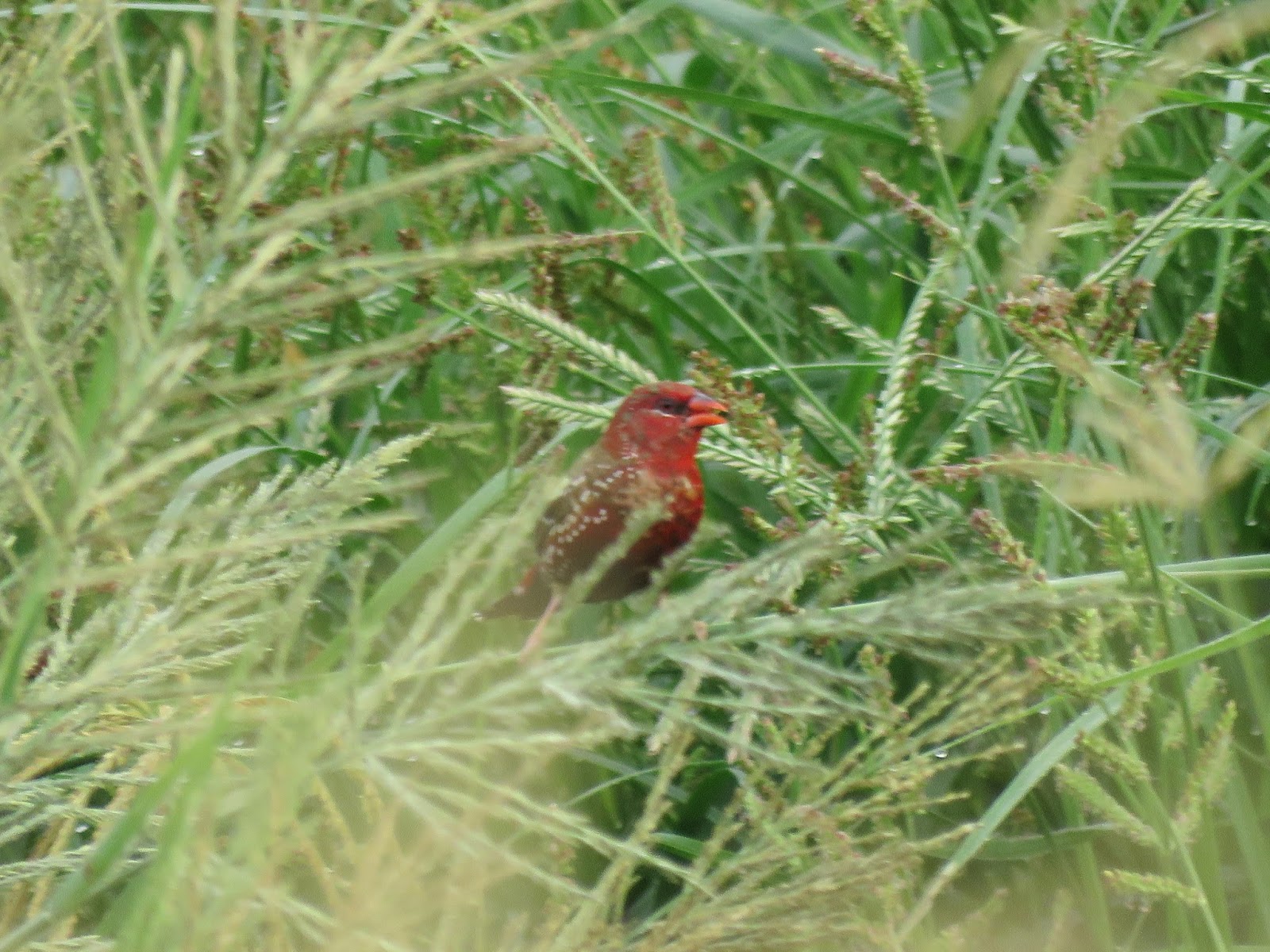


red avadavat, red munia or strawberry finch (Amandava amandava)

The Red Avadavat were around in good numbers today, as far as I know this is close to their breeding time back in their homeland in India and it might explain why there were so many about and they all seemed extremely busy.


European stonechat (Saxicola rubicola)
A regular visitor to the area during passage season is the Stonechat which usually appears in reasonably large numbers this time of year.  Today I only saw two, this gent and a female at the opposite end of the field.


European stonechat (Saxicola rubicola)
And the female of the species I believe.


Namaqua dove (Oena capensis)

Namaqua Doves were around in good numbers again today and as ever they are a joy to watch. They were not a common as their cousins the Laughing Dove which were quite literally everywhere but in good numbers nonetheless.


white-throated kingfisher (Halcyon smyrnensis)

The White Throated Kingfisher is a local around these parts and can be seen most days somewhere in the area.


common kestrel (Falco tinnunculus)
It was nice to see a fairly regular visitor to the area, the Kestrel was happily sitting on the sprinkler arm watching the world go by.

marsh harrier (Circus aeruginosus)

Further along there was a March Harrier.  The photo is not great as it was a quite a distance, I can never seem to get close to these guys.


Montagu's harrier (Circus pygargus)


However there were a couple of raptors about the place which did not look like the same old bunch, not least because these guys were quite happy to land close to me and start having lunch.  Young birds often need a little time to get sense when it comes to how they behave around human and these two young Montagu's Harriers were no exception.  I only hope they get wary before some clown with a gun gets to them.  Anyhow they are this weeks new bird for me which was very pleasing.


black-winged kite (Elanus caeruleus)
A new old friend from last week was still about the place.  The White Winged Kite was still here, although I only saw one on this occasion and not for very long.

blue-cheeked bee-eater (Merops persicus) plus laughing dove (Stigmatopelia senegalensis)
  
A couple of Blue Cheeked Bee Eaters and a Laughing Dove checking each other out on the sprinkler arm.  Actually I think they are all keeping an eye on the Kite which was just behind them on the wire!!  This really was a day for the Blue Cheeked Bee-Eater as I saw at least 30 on the road in and around the fields.  It truly is the passage season.


"Isabelline (or Red-tailed) Shrike" Lanius

This Turkestan Shrike was eyeing up his next victim when I caught this photo.  Thee were not quite as many Shrikes about today but still managed to see this guy, a Daurian and a Masked Shrike, although the photos were not great. 
barn swallow (Hirundo rustica)

The Barn Swallow were about in even larger numbers this week with virtually no area of the sky not occupied by at least one.  They were mostly all frantically feeding on the rich bounty of insects around the place, or at least on the ones who had not decided to swarm all over me as I moved along.


barn swallow (Hirundo rustica)
They are still lining up on the wires ready for their trip, although I guess that these are a different lot to those that passed through last week.  It is passage season after all.


purple heron (Ardea purpurea)

The Purple Heron was about in reasonable numbers today with this one posing on top of a tree watching me very carefully indeed.


squacco heron (Ardeola ralloides)


His cousin the Squacco Heron was much less accommodating only allowing this quick shot before taking off into the distance.  There were not quite so many of these guys around this week but then the sprinklers were off so they may have gone somewhere else.  The Cattle Egret on the other hand were still about in very large numbers, well over a hundred were counted this week on the sprinkler arm, however due to the misty conditions I could not get a clear photograph.

Another day another new bird!  The temperatures getting down to acceptable levels, blue skies, lots of birds....What's not to like.


Friday, 23 October 2015

Monday, 19 October 2015

Return to Al Hayer 17 October

Last weekend I returned to Al Hayer after a break away due to work and illness.  I was still not feeling tip top so only had a short walk among my familiar friends.  However, you can never tell what you are about to come across when birding in Saudi Arabia.  In this instance I had the pleasure of spotting the following amazing creature;


black-winged kite (Elanus caeruleus)

Perched in a tree about 20 meters away was a Black Winged Kite, a very rare visitor to the area.  I know they are seen occasionally in the Eastern Region but not around Riyadh.  He did not seem overly bothered by my presence so I got to watch for a while, eventually remembering to take some photos.  Eventually he flew off to the north, however to my amazement about 5 minutes later I spotted another coming in from the west over the reeds and flying low across the reeds.  I'm still trying to make something of a poor in flight shot and will put it up here when I can but, what can I say, like a London bus, wait and wait then 2 show up !!


desert finch (Rhodospiza obsoleta)
In the bushes was a small flock of Desert Finch.  I have seen these in the area a few times before but generally limited to one or two birds, in this instance there were 8 to 10.  A pretty little bird.


purple heron (Ardea purpurea)

The Heron family was well represented today with the Purple Heron making an early pass over where I stood.


squacco heron (Ardeola ralloides)

And I guess around 25 Squacco Heron feeding away in the long crops.  They show up en-mass at this time of the year and spend most of the winter around the area.


cattle egret (Bubulcus ibis)

However the real flock winner for this week was the Cattle Egret which were really here in large numbers.  The photo below was not able to capture the full flock but got most of it, over 100 birds I guess.


cattle egret (Bubulcus ibis) 75+

In addition to these guys there were a small number of Grey heron about but I did not manage to photograph them on this occasion.

Indian silverbill or white-throated munia (Lonchura malabarica)

Another bird that often appear is flocks is the Indian Silverbill but on this occasion there were only a small number to be seen.


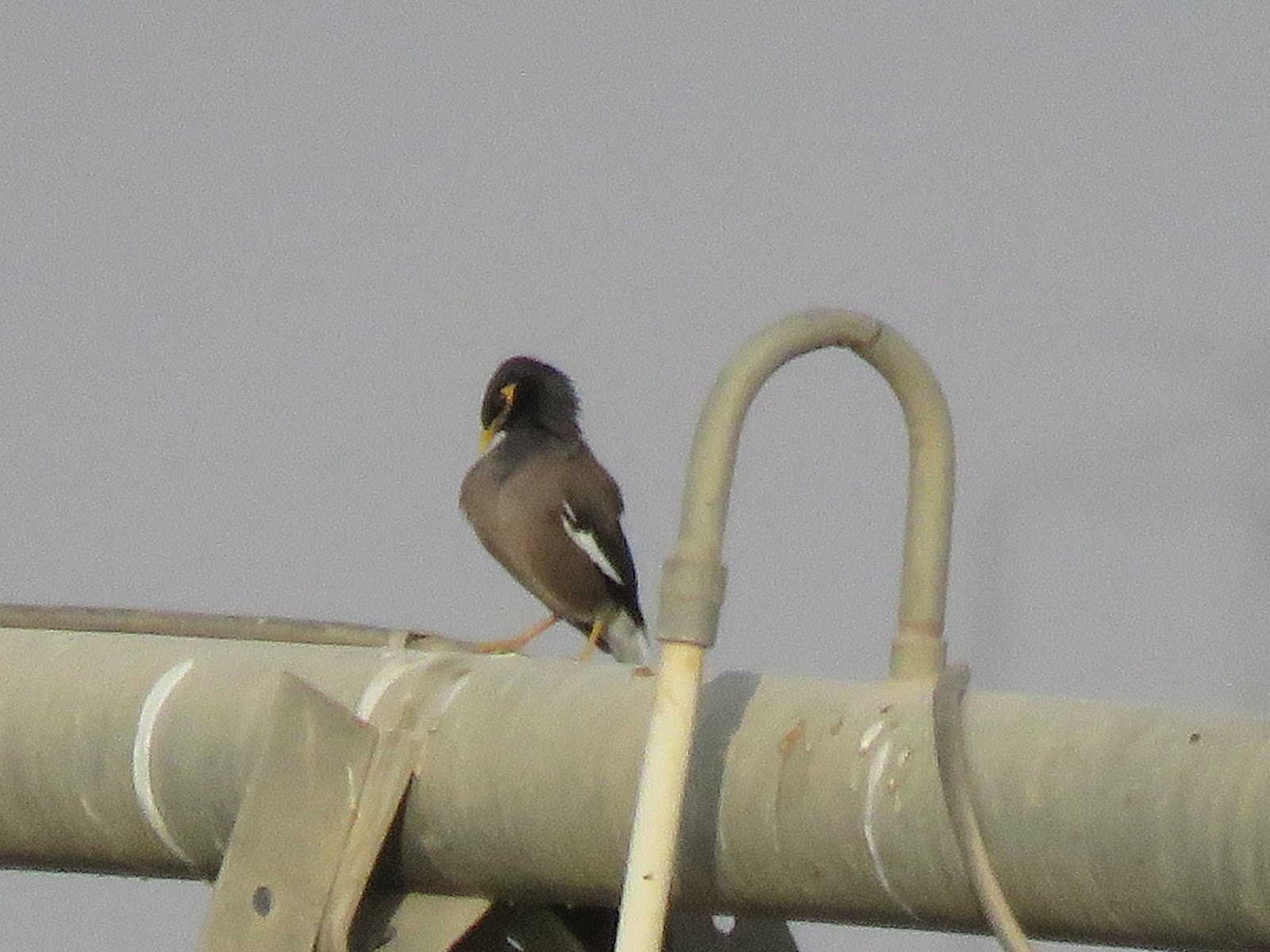
common myna (Acridotheres tristis),

The Common Myna are regular visitors to the area and usually in small flocks.  On this occasion there were only 2 that I saw but it may be there were more in among the crops.


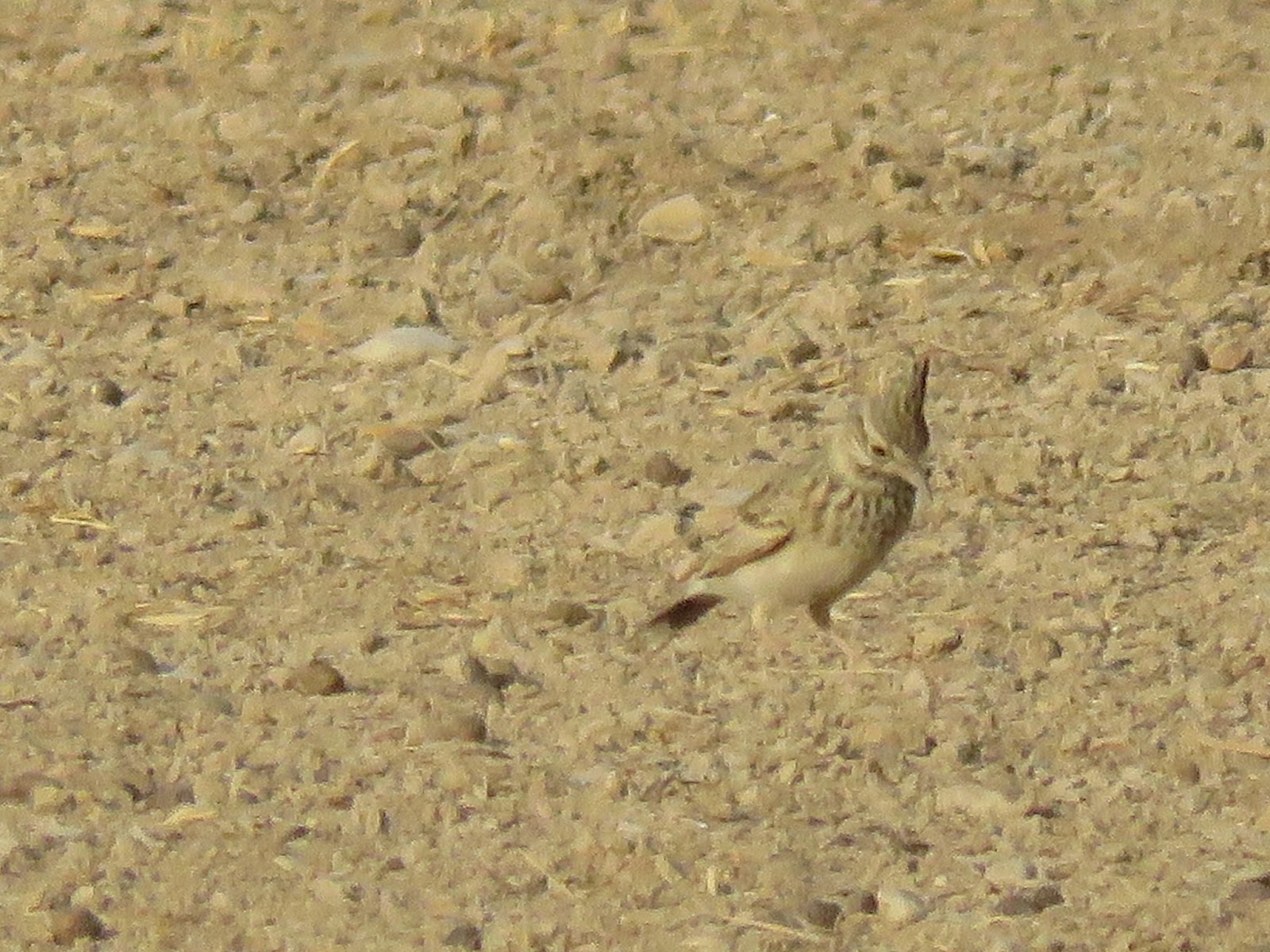
crested lark (Galerida cristata)

As always there were a good number of Crested Lark about the place.  This one is well hidden in plain sight, most are heard well before they are seen as they have a distinctive chirp. 


white-throated kingfisher (Halcyon smyrnensis)

Another familiar sight around the area is the White Throated Kingfisher, today they were hanging around their favourite perch on the sprinklers.  There were 3 about today, two appeared to be together while the third was a short distance away.


Namaqua dove (Oena capensis)
There were a good number of Namaqua Dove around today and, as always, a large number of Laughing Dove. 

barn swallow (Hirundo rustica)

This is a longish range shot showing the Barn Swallows lined up on the wires preparing to head south for the winter.  There were in excess of 50 on the wires around the fields and about the same number feeding all around the area.  I expect they will be moving off in the next week or so.


green bee-eater (Merops orientalis)

A favourite resident is our little friend the Little Green Bee Eater.  My day is never complete until I have seen at least one of these.  As it happens I only did see the one on my walk but there were 5 or 6 on a wire as we drove back so there were more about.


white-eared bulbul (Pycnonotus leucotis)
The White Eared Bulbul were also about in good numbers though not as vocal as they normally are, might not have been a good day for them.  There were also a good number of Graceful Prinia about the place but I did not manage to get any photos of them this time.


red avadavat, red munia or strawberry finch (Amandava amandava)
A common enough visitor is the Red Avadavat, there were 7 or 8 of these about today and I heard a few others singing in the reeds.  This one looks like he is carrying nesting material

 common moorhen (Gallinula chloropus)
All over the wetland areas were the Common Moorhen.  They are all very skittish as there are one or two hunters about but managed to get this shot.

As I said this was a short walk today lasting about 2 hours but nonetheless exciting.  All goes to prove you never know what you will come across while birding. 


Monday, 31 August 2015

Harvest Time At Al Hayer 29/8/15

Hi there, not been keeping up with blogs over the past while as I have been involved in other things of late which have taken quite a bit of time.  This does not mean I have not been birding, I have, just not been writing things up.  Part of this was work but a good deal of the cause was the purchase of a new camera and to be honest, that has been taking a lot longer to get used to than I planned.  I will try to catch up over time.


I went out on Saturday 29/8/15 to do a little birding around my local area at Al Hayer.  Akram and I have done some longer trips to AlKharj and Dammam recently so I thought just a local trip would be a bit of a rest from driving.   As I was to discover this was to be a really good day to do this and in the end I had the best day I have had at this site in quite some time.


We arrived at around 5:45am and I set out across slowly across the fields.  The crop in the lower field had been recently cut so there was a lot of barley seed about to attract the birds in, in addition the second field had quite recently been ploughed and was ready for sowing which also attracted other birds to the area.
I brought a monopod with me as one of the problems I have been having is keeping the camera steady for longer shots, the anti shake on this Canon is nothing like as good as the Lumix.


I watched a couple of House Sparrow in the bushes for a while;


when I noticed a Masked Shrike perched in a bush behind them.  This guy seemed quite relaxed and sat on the branch for quite some time.


As I came to the entrance of the lower field I noticed a flash of black and white wing as a Hoopoe took off over the top of the reeds, this was one of the two I saw this morning, unfortunately I was not fast enough to get a photo of either of them.


Overhead there were a small group of Barn Swallows darting across the sky in search of insects and when I reached the middle field there were about 25 of them in total feeding merrily.


As always the Laughing Dove was present is significant numbers, but on this occasion they were almost outnumbered by the Namaqua Doves which were quite literally everywhere.


There were also good numbers of Pigeons and Eurasian Collared Dove to be seen.


Overhead I spotted a coupe of Grey Heron a single Purple Heron and a small flock of 15 Cattle Egret, all making their way north for the day.


Along the field were the family of Common Moorhen I have spotted many times before.  There were a mix of adult and younger birds but all were full size, the younger ones had yet to moult.  This was a little different to Al Kharj a week or so ago where the young were only a few days old.


Another bird I spotted in the fields was the Indian Silverbill.  There were a good number of these spread over a largish area of the field.  I can't remember when I last saw this species around the area, definitely not since the very early part of this year.


The bushes were alive with the sounds of the tiny Graceful Prinia that chased each other around the bushes.


Also seen in good numbers were the Streaked Weaver which can be seen in great numbers around this place.
As I approached the first pumping station I heard the familiar song of the Red Avadavat, although initially I could not see it.  To my delight as I got close to the pump there were three brightly coloured males in the same bush.  A delight to watch and hear, although I did not get close enough for really good shots.


On passing the pump station I followed the sprinkler device up along the field.  Siting on the near end of this was three young Little Green Bee-Eaters which I attempted to photograph.


I then noticed a small flock of Sparrows flying up and down from the sprinkler to the field and back, but among them was a flash of white and black wing that was no Sparrow, I investigated further and found it was a Woodchat Shrike. 


I am not sure if the Sparrows were uncomfortable with his being there as he soon flew (or was chased) a little distance from them only to be replaced by a Lesser Grey Shrike.  I think at this point the sparrows decided to go somewhere else.


I walked across the road to the ploughed middle field and immediately noticed this small dark grey bird in the distance but could not make out what it was.  As I moved further up the field I spotted another then another finally seeing about 25 + Collared Pratincole spread out across the field.  Some were clearly quite young and came fairly close bit the darker coloured ones, which I assume were older, did not.


In addition to the Pratincole there were large number of Rock Dove, Feral Pigeon out in the field and occasional groups of House Sparrows and Silverbills. 


Out in the field along with the others were a number of Black Scrub Robin


and a good number of Crested Lark.


As always there were a number of White Eared Bulbul along the walk, although not nearly as many as usual in the area.  Maybe they had all congregated at the other side of the river.


The trees were alive with the sound of Sparrows but I could not see in to see which type they were.  Its funny how there can be so much chatter coming from a tree making you think the branches will be full to bursting with birds, yet you can't see them.


I continues my trek along the side of the field past the second pumping station towards a small lake which was between the two middle fields.  There are usually a few waders and the odd heron around there but alas today there was only a group of Philippine fishermen.  That said there were a couple of Stint feeding along the far end and another 4 or 5 Common Moorhen.


As I came around the side of the lake I spotted a Squacco Heron Standing out in the open and moments later a Spur Winged Lapwing (plover) landed nearby and headed straight for the shade.


By this time it was getting on for 9:30 and the heat was increasing rapidly, I decided to take the Lapwings advice and head back for the car.  I walked out towards the road spotting more Crested Lark, more Pratincole and Pigeons along the way.


Suddenly a bird flushed from the field about 20m ahead and flew by quickly back in the direction I had come from.  Luckily it landed about 50m away, so I shot back to get as close as I could.  I noticed it was not a bird I recognised at all and had a completely different Jizz.  As luck would have it I managed to get some reasonable photos of the bird and was able to tidy these up enough to see that it was a Cream Coloured Courser, a new species for me. 


A good day made brilliant is probably the best description I can use for the days birding and all from our little home patch!


Happy Days :)


OR WOULD BE IF I COULD WORK OUT WHAT THE HECK IS GOING ON WITH PAGE FORMATTING


Sunday, 28 June 2015

Rainy Day in Lancashire 20/6/15

After nearly 5 months beached in Saudi Arabia due to administrative issues I managed to get home for a few days last week and despite all the comings and goings of sorting out a new house I also managed to get out for a bit of birding.  Weather was forecast as showers with bright spells but as ever the bright spells got washed away but I was determined to get out come rain or shine, so the rain won!!

Anyhow I did have a wonderful day out despite the weather and got to see a good selection of birds.  Was not terribly successful photographing some of them, which we can put down to the weather.  Although my bum still hurts after crashing down the stairs trying to get to the camera before a beautiful Jay departed my new back garden.  Ho hum, the joys of birding, yes you guessed it, he got away!!

These are the ones that didn't;


rabbit (Oryctolagus cuniculus)
Ok so not exactly a bird!  There are about 30 rabbits happily residing in the field across from my house and in the early morning they pop out for a little breakfast.  Sensibly they are pretty skittish and vanish into their burrows at the slightest sign of movement.  There are a small number of deer in the woods behind, I have seen them a number of times in the past but not on this occasion.


common moorhen (Gallinula chloropus)
Immediately behind the rabbits was a pair of Common Moorhen who also take advantage of the low grass and readily available cover.  It is a little unusual to see them this far from water around here, this being about 40 or 50 meters.


Mallard (Anas platyrhynchos)
In the river along my walked were a significant number of Mallard.  There are about 30 along the mile long stretch  of Colne Water and as you can see there are now a couple of juniors joining the ranks.  This mother had 3 young with her.


Mallard (Anas platyrhynchos)
There was no sign of a male around the little family but I got this photo of one a little later.


common magpie (Pica pica)
The crow family are very active around our area with large numbers all over the place.  There were dozens of Magpie in the area.  I had a fascinating experience with these while I was at home during the week.  I put some bird food out in a hanging basket by a fence at my house.  Its mainly intended for small birds and while it is secure, it looks a little weak to support heavier birds.  The Magpie clearly thought so too but landed on a fence nearby (maybe 15-20cm away) and proceeded to use a small branch from a nearby young tree to pull the hanging basket over to where it was.  A tricky exercise as every time it let go of the branch the basket swung back out of reach.  But I have no doubt by the time I return again they will have worked this out.


 long-tailed tit (Aegithalos caudatus)
Every morning we awoke to the sound of hundreds of birds singing.  All the local small birds were represented, the Blue Tit, Great Tit, Blackbird, Chaffinch, and a selection of warblers.  The little groups of Long Tailed Tits were also active but they are not quite so loud.


jackdaw (Corvus monedula)
Everywhere the Jackdaw!!  Literally this has to be one of the most common of the crow family around our area.  Virtually every view of the sky will have at least one if not dozens.


mandarin duck (Aix galericulata),
One bird that was a bit unusual was the Mandarin Duck.  This female with 3 or maybe four juveniles.  These are not known to breed in the area and are rarely seen this far north, although I have seen a pair of them on one occasion in the past. The male of this species is one of the most colourful of all birds, the female less so but nonetheless a handsome bird, I think. I have reported these to the local experts and will see what they have to say.


carrion crow (Corvus corone)
I got a number of photos of the Carrion Crow on my walks around the area but came across this guy and his partner on a couple of fence posts by the grave yard.  It was raining when i took the photos and they seemed to be perched there hunkering down and not enjoying the rain.  (or maybe they loved it and it was just me who didn't, who knows).


mute swan (Cygnus olor)
At the Foulridge end of the lake I found 3 Mute Swans feeding in the long grass.  I have been down here quite a few times since moving to Lancashire but can't remember ever seeing these birds on the lake.  I am sure they must do as they are not at all rare around the area but as I say I never saw them there.

great crested grebe (Podiceps cristatus)
A very common sight on the lake is the Great Crested Grebe.  On the day I visited there were 6 or 7 but have often seen many more.  I don't think I will ever tire of watching this bird, its do beautiful.  I have never yet managed to see them do their pair dance first described with great excitement by J.S.Huxley at the turn of the last century.  One of these days. :)


white/pied wagtail (Motacilla alba)
The area around Colne is usually good for seeing Wagtails like the Pied Wagtail above, but on this day I only spotted the one and at a bit of a distance.  I did not see any of the Grey Wagtails that usually inhabit the river area at this time of year.


common blackbird (Turdus merula)
An ever present delight in the area are the Blackbirds which wake you every morning with their song and screech their shrill warning calls everywhere you go, especially when you have just spotted something interesting.  Still despite this you have to love these cute little birds. 
 
 common wood pigeon (Columba palumbus)
The Wood Pigeon is one of these birds that is everywhere. God knows how many there are in the UK but I guess it must be millions.


Finally, perched right on the top of a tree at the bottom of my garden was a dapper looking Dunnock.  I have to admit this is the first time I have seen one of these perched on top of a tree, I normally see them in the undergrowth.
 
As always, my birding day was most enjoyable even if it was spilling with rain all day.  Still back to the desert next week and a slightly different type of climate challenge.